See your Tabby Cat in Watercolor — free, in about 40 seconds.
Try the free preview →Why Tabby Cat in Watercolor
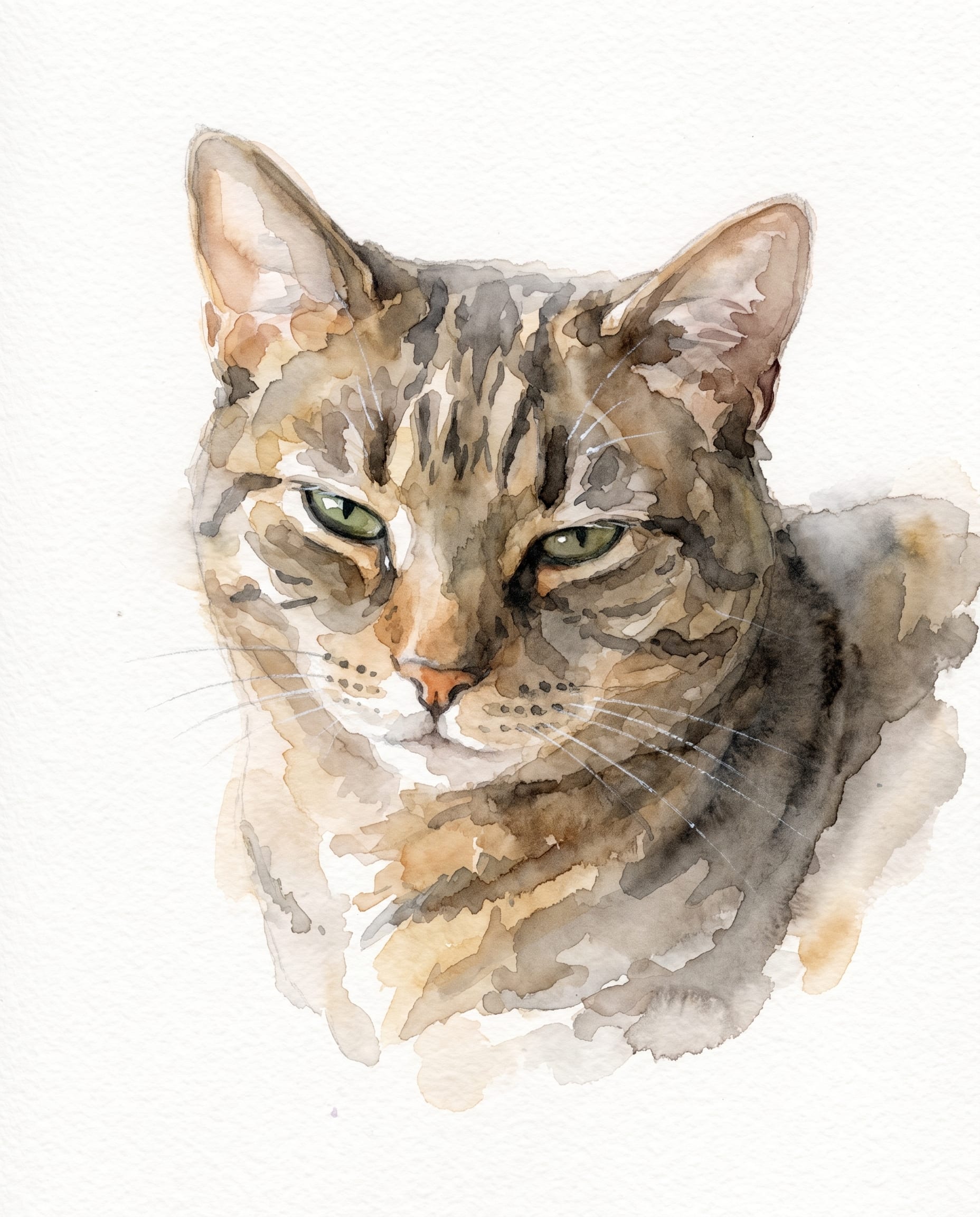
Tabby markings — the M on the forehead, the broken stripes, the ticked agouti undercoat — are exactly the kind of layered, complex patterns watercolor handles best. Each stripe becomes a separate wash; the pattern emerges from wet-on-wet layering instead of being imposed on top.
The photo that works best
Natural window light from the side brings out the tabby's pattern contrast — the dark stripes separate from the lighter ground more clearly with directional light than with flat overhead light. Avoid direct flash; it washes out the agouti ticking that makes tabby coats interesting.
More general guidance in our best photo for a pet portrait guide and the breed-specific tips on /breeds/tabby-cat.
Common questions
Will the M marking on the forehead show up?
Yes. The M — the defining tabby forehead marking — is one of the first details the model resolves because it's a high-contrast linear feature in a compact area. It's visible in the painting, not lost in the wash.
My tabby is a mackerel tabby — will the narrow stripes render correctly?
Mackerel tabby (narrow parallel stripes) is one of the most rewarding patterns for watercolor because each stripe becomes a distinct tonal wash. The painting looks like a botanical study of the pattern. Classic tabby (blotched) reads more painterly; spotted tabby falls somewhere between. All three render well.
Watercolor vs. oil for a tabby cat?
Watercolor for the cat as indoor companion — luminous, quiet, living-room scale. Classic or Renaissance oil for the cat as subject — formal, rich, commanding. Watercolor suits cats who are photographed in domestic settings; oil suits cats who are photographed with a look of judgment. Both options are free to preview.
Explore more
- Tabby Cat portraitsAll 8 painting styles for your Tabby Cat — coat, markings, and personality tips.
- Watercolor deep-diveWhat Watercolor looks like, which pets it suits, and how to frame it.
- Golden Retriever in WatercolorGolden Retrievers and watercolor meet at the coat: the warm amber-to-cream range sits in watercolor's native palette, and the loose washes render individual fur striations rather than smoothing them into a monochrome block. What comes back looks like a study for a larger painting — open, luminous, specific to that dog.