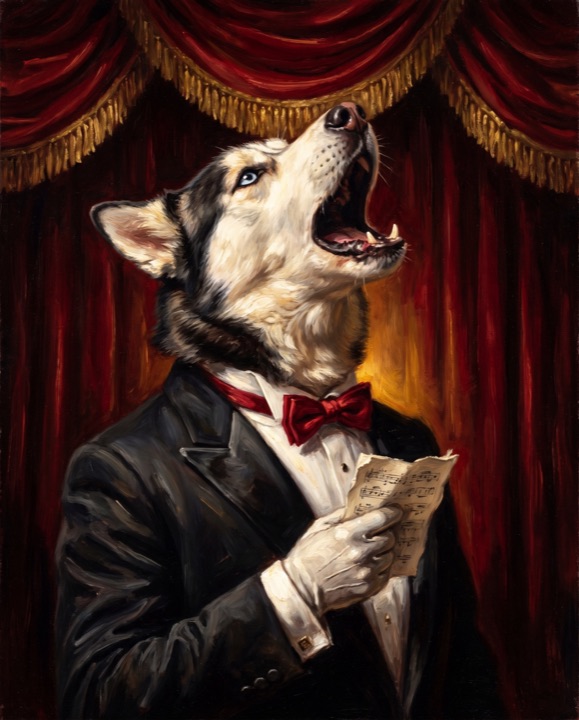
Huskies are one of the most photogenic breeds on the planet — the mask, the eyes, the coat pattern all read across the room. Cinematic, Van Gogh, and Renaissance all reward them. Free preview in about 40 seconds.
The Siberian Husky is the breed painting mediums line up to render. Blue eyes (or heterochromia — one blue, one brown), the specific facial mask, the wolf-adjacent silhouette, the thick double coat — every element of a Husky reads as intentional visual design. Cinematic makes them look like National Geographic subjects; Van Gogh treats the coat as swirling brushwork; Renaissance gives them wolf-noble gravitas.
One photo, about 40 seconds, free preview. Standard black-and-white, agouti, red-and-white, sable, all-white — every Husky coat color renders accurately from the specific dog in your photo.
Why Huskies are painting mediums' favorite dog
- The mask is composition. The specific placement of dark markings around the eyes, muzzle, and forehead gives the paint model natural focal geometry. Every medium has anchor points to work from — Cinematic especially rewards the mask contrast.
- Blue eyes carry the composition. Blue-eyed Huskies, heterochromatic Huskies (one blue one brown), split-eyed Huskies — the eye variation is unmatched in dogdom. Every painting medium loves the specific eye render.
- The double coat is a canvas. Long guard hair + dense undercoat = texture that reads at every scale. Van Gogh renders it as directional brushwork; Impressionist as broken color; Oil as depth.
Best painting styles for a Siberian Husky
- CinematicStudio-photograph polish. Blue-eyed Huskies especially — the medium loves the eye contrast and mask pattern together. Top-choice for Husky wall art.
- Van GoghThick swirling brushwork. Huskies in snowy landscapes were made for the medium — every coat strand becomes a directional stroke.
- RenaissanceOld Master oil with dramatic chiaroscuro. Huskies in Renaissance read as wolf-noble subjects — the wildness carries into court-companion register.
- Classic OilWarm, timeless, mantel-worthy. The everyday Husky portrait — anchors a family room with the pack-dog register.
Or read the full style guides: Cinematic, Van Gogh, Renaissance, Classic Oil.
See your Siberian Husky in every medium — free, in about 40 seconds.
Try the free preview →What photo works best
- Get the eye catchlight. Husky eyes want a photo where they show a small window highlight — the paint amplifies whatever the source emphasizes.
- Alert posture. Huskies at attention (ears up, gaze focused) paint dramatically better than relaxed shots — the wildness needs alertness to read.
- Cool light or shade beats direct sun. Direct sun blows out the mask contrast; even light or overcast weather lets the coat pattern read.
- Outdoor shots especially rewarding. Huskies were bred for the outdoors — the paint respects them best in the environment they were built for.
Want more detail? Read our full guide to the best photo for a pet portrait.
How it works
- Add one photo. Any clear shot of your Siberian Husky — close-up or full body.
- Pick a style. Renaissance, Watercolor, Cinematic, Pop Art, and 4 more. Or take our 30-second style quiz.
- Preview in ~40 seconds. No card, no sign-up. Try as many looks as you want.
- Order the print. Framed giclée, canvas, poster, or metal — museum-mounted by Prodigi, ships to the US & Canada.
Common questions
Will the paint keep my Husky's specific eye color combination?
Yes — Husky eyes are one of the most preserved features. Blue, brown, heterochromia (one of each), split-eye (both colors in one eye), and the rarer parti-eye all render accurately. Blue-eyed and heterochromic Huskies are among our top-ordered portraits.
What about coat color — black-and-white, red, agouti, all-white?
Every Husky coat color renders accurately. Black-and-white (most common) reads across every medium. Red-and-white is warmer in Oil and Impressionist. Agouti (wolf-like) shines in Cinematic. All-white Huskies pair especially well with Charcoal.
Can I get my Husky in snow or an Arctic scene?
Yes. Custom-prompt handles specific setups ("running through snow", "in a snowy pine forest", "under Northern Lights"). Scene picker also has Explorer for a wilderness-photography register.
What about Husky mixes — Alaskan Malamute, Utonagan, wolf-dog?
Any pet from any photo. Malamutes paint like larger, heavier Huskies. Wolf-dog mixes render with the specific wild features preserved. Alaskan Klee Kai (mini Husky lookalikes) render accurately at their actual size.
How much does it cost?
Preview is free. Real photo prints start at $14.95, framed prints run $179–$299 depending on size and finish. Every print ships with the hi-res digital file — included free.
Memorial portrait for a pet you lost
If you're here because your Siberian Husky passed, we've written a separate guide on how we approach memorial portraits — the older-photo question, the framing choice, and the pieces we've made for other families going through the same thing. Read the memorial guide →
Other breed guides
- French BulldogFrenchies have some of the most expressive faces in dogdom — big eyes, batty ears, that trademark side-eye. Renaissance, Pop Art, and Cinematic styles catch it best. Free preview in about 40 seconds.
- Labrador RetrieverLabs are the most-owned breed in America — that blocky face and short coat suit Oil, Impressionist, and Cinematic best. Yellow, black, chocolate, all render beautifully. Free preview in about 40 seconds.
- Golden RetrieverGoldens are the most-painted breed for a reason — that warm coat and open face flatter every medium. Impressionist and Oil hit hardest; Watercolor softens for a nursery register. Free preview in about 40 seconds.
- German ShepherdGSDs have one of the most sculptural faces in dogdom — that mask, those ears, the alertness. Renaissance, Cinematic, and Oil catch the noble register best. Free preview in about 40 seconds.
- DachshundDoxies have one of the most graphic silhouettes in dogdom — the long body, big personality, that specific face. Pop Art, Watercolor, and Cinematic all lean in. Free preview in about 40 seconds.
- GoldendoodleDoodles are all about the coat — those soft curls and warm cream-to-apricot tones. Watercolor and Impressionist mediums render them best. Free preview in about 40 seconds.