See your Corgi in Renaissance — free, in about 40 seconds.
Try the free preview →Why Corgi in Renaissance
The corgi's wide-set eyes, fox-like face, and upright bearing are period-portrait hallmarks — the same features 16th-century painters emphasized in aristocratic sitters. Painted in Renaissance oil against a crimson-draped interior, a corgi reads not as cute-dog but as sitting sovereign.
The photo that works best
A seated or standing pose, slight three-quarter angle, ears fully erect — the triangle formed by the two pricked ears and the fox face is the corgi's strongest silhouette, and Renaissance framing benefits from a clear head shape. Avoid photos where the ears are folded or in motion.
More general guidance in our best photo for a pet portrait guide and the breed-specific tips on /breeds/corgi.
Common questions
Is the Queen connection a joke or does it look genuinely regal?
Genuinely regal. The Renaissance treatment doesn't wink — it commits. The corgi's head shape, erect ears, and alert expression are painted with the same seriousness a Flemish portraitist brought to a duchess. The joke, if there is one, is that the painting is so good it's not a joke.
Pembroke vs. Cardigan — does the breed difference show in the painting?
Yes. The Pembroke (no tail, sharper fox-face) and Cardigan (long tail, larger ears, stockier body) read differently in a Renaissance portrait. The Pembroke tends to read more regal; the Cardigan more imposing. Both work well — the difference shows up in body proportion and head shape.
Should I use the Queen scene instead of just Renaissance style?
The Queen scene adds the costume — ermine robe, crown, throne. Renaissance style alone is a formal painted portrait without costume. For a wall piece that reads as portraiture, Renaissance style. For a piece that says 'my dog is literally the monarch,' the Queen scene. The two are complementary; you can do one now and the other later.
Explore more
- Corgi portraitsAll 8 painting styles for your Corgi — coat, markings, and personality tips.
- Renaissance deep-diveWhat Renaissance looks like, which pets it suits, and how to frame it.
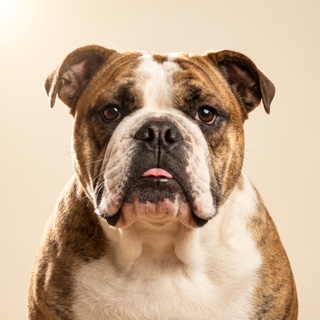
- English Bulldog in RenaissanceAn English Bulldog in Renaissance oil doesn't need costume or conceit — the jowled, heavy-set gravitas of the breed already occupies the same visual register as the Flemish sitters Rubens and van Dyck painted in ermine and velvet. The heaviness reads as weight of authority, not excess weight.
- French Bulldog in RenaissanceThe Frenchie's bat ears and compact proportions — features that read as endearing oddities in real life — land as aristocratic distinction against a Renaissance oil backdrop. The same asymmetries Flemish portraitists used to individualize Habsburg nobles work here: the broad forehead, the erect ears, the eyes that hold the viewer.
- Golden Retriever in RenaissanceA Golden Retriever in Renaissance oil is the portrait the breed has been waiting for. The warm chiaroscuro picks up the coat's natural amber depth; the three-quarter pose and dark backdrop give a dog who already carries itself with quiet nobility the visual register to match.