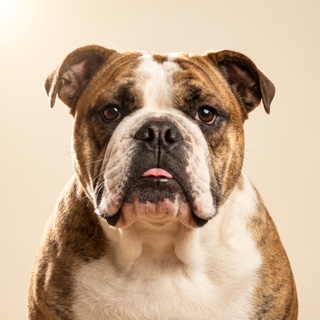
See your French Bulldog in Renaissance — free, in about 40 seconds.
Try the free preview →Why French Bulldog in Renaissance
The Frenchie's bat ears and compact proportions — features that read as endearing oddities in real life — land as aristocratic distinction against a Renaissance oil backdrop. The same asymmetries Flemish portraitists used to individualize Habsburg nobles work here: the broad forehead, the erect ears, the eyes that hold the viewer.
The photo that works best
Front-facing or slight three-quarter angle, at eye level (not above — the overhead angle foreshortens the bat ears, which is the Frenchie's best feature in a Renaissance treatment). Natural or window light; the model needs shadow depth to build the chiaroscuro the treatment is known for.
More general guidance in our best photo for a pet portrait guide and the breed-specific tips on /breeds/french-bulldog.
Common questions
Does the bat-ear silhouette work well in a Renaissance composition?
It's one of the best silhouettes for the format. Renaissance portraiture relies on a strong head profile — the ears create a distinctive, immediately recognizable outline that reads as signature rather than quirk. The painting treats them as the feature they are.
My Frenchie has a fawn brindle coat — will that render correctly?
Yes. Brindle — especially fawn brindle — responds well to the layered glazing technique in oil-based styles. The alternating light and dark striping becomes a textural detail rather than a pattern problem. You'll see each stripe in the painting.
Should I use Renaissance or Classic Oil for my French Bulldog?
Renaissance for formal + dark-backdrop drama (excellent for brindle and dark-coated Frenchies). Classic Oil for warm + intimate (better for fawn and light-coated Frenchies where the dark Renaissance backdrop would create too much contrast). Try both free — previews take 40 seconds each.
Explore more
- French Bulldog portraitsAll 8 painting styles for your French Bulldog — coat, markings, and personality tips.
- Renaissance deep-diveWhat Renaissance looks like, which pets it suits, and how to frame it.
- Corgi in RenaissanceThe corgi's wide-set eyes, fox-like face, and upright bearing are period-portrait hallmarks — the same features 16th-century painters emphasized in aristocratic sitters. Painted in Renaissance oil against a crimson-draped interior, a corgi reads not as cute-dog but as sitting sovereign.
- English Bulldog in RenaissanceAn English Bulldog in Renaissance oil doesn't need costume or conceit — the jowled, heavy-set gravitas of the breed already occupies the same visual register as the Flemish sitters Rubens and van Dyck painted in ermine and velvet. The heaviness reads as weight of authority, not excess weight.
- Golden Retriever in RenaissanceA Golden Retriever in Renaissance oil is the portrait the breed has been waiting for. The warm chiaroscuro picks up the coat's natural amber depth; the three-quarter pose and dark backdrop give a dog who already carries itself with quiet nobility the visual register to match.