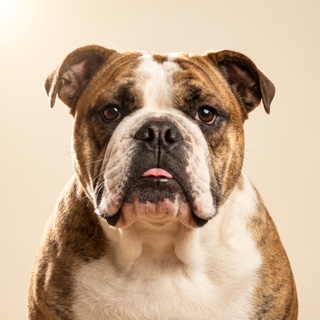
Aussies have some of the most visually striking coats in dogdom — merle patterns, blue eyes, working-dog build. Impressionist, Cinematic, and Watercolor render them best. Free preview in about 40 seconds.
The Australian Shepherd is the breed painters find themselves choosing when they want to show off. Merle coat patterns, one blue eye and one brown, or two blue eyes — Aussies carry more built-in visual drama than any other common breed. Every one of our eight painting mediums surfaces something distinctive from an Aussie photo.
One photo, about 40 seconds, free preview. Blue merle, red merle, black tri, red tri — the paint respects the specific coat you have.
Why Aussies are one of the most photogenic breeds
- Merle patterns are the paint's dream input. The specific blue-and-black or red-and-cream mottling reads as brushwork before the paint even touches it. Impressionist and Watercolor especially reward the merle.
- The eyes carry weight. Blue eyes, heterochromia (one blue one brown), split eyes — Aussies have one of dogdom's most striking eye repertoires. Cinematic captures the catchlight; Watercolor softens it.
- Working-dog build reads powerful. Aussies stand and move with an athletic presence most family breeds don't. Full-body shots reward the shoulders and stance — canvas and poster formats especially strong.
Best painting styles for an Australian Shepherd
- ImpressionistDappled light and broken brushwork in the manner of Monet. The merle coat becomes native to the medium — every mottle reads as a considered stroke.
- CinematicReal studio-lit photograph. Blue-eyed Aussies especially shine — the medium loves the eye contrast and coat pattern together.
- WatercolorSoft, airy, family-forward. Warmer than Impressionist, gentler than Oil — best when the Aussie is a family pet and you want approachability over drama.
- Classic OilWarm, timeless, mantel-worthy. Anchors a room for the next 30 years. Best for solid-color Aussies where the tonal warmth carries the coat.
Or read the full style guides: Impressionist, Cinematic, Watercolor, Classic Oil.
See your Australian Shepherd in every medium — free, in about 40 seconds.
Try the free preview →What photo works best
- Even light. Merle coats need light that reads the mottled pattern — direct sun blows out the pattern that makes the coat distinctive.
- Three-quarter angle. Get both the face and the coat pattern in the frame.
- Outdoor shots suit Aussies — they photograph as the working dogs they are. A backyard, trail, or field shot rewards Impressionist and Cinematic.
- Focus on the eyes. Blue-eyed Aussies especially want a photo where both eyes are visible and in focus — the paint amplifies whatever the source photo emphasizes.
Want more detail? Read our full guide to the best photo for a pet portrait.
How it works
- Add one photo. Any clear shot of your Australian Shepherd — close-up or full body.
- Pick a style. Renaissance, Watercolor, Cinematic, Pop Art, and 4 more. Or take our 30-second style quiz.
- Preview in ~40 seconds. No card, no sign-up. Try as many looks as you want.
- Order the print. Framed giclée, canvas, poster, or metal — museum-mounted by Prodigi, ships to the US & Canada.
Common questions
My Aussie is a blue merle with one blue eye. Will both eyes and the coat pattern be preserved?
Yes — this is exactly the case the paint model handles best. Merle pattern, heterochromia, the specific proportion of blue to black in the coat — all carry through head to tail. Blue-eyed merle Aussies are one of our top-ordered portraits.
What about mini Australian Shepherds or Toy Aussies?
Same process, same paint. Mini and Toy Aussies work identically to Standard Aussies — the paint doesn't care about height, only the photo. Smaller print sizes suit smaller dogs; wall-anchor sizes work but feel scaled up.
Can you get my Aussie herding or in a working scene?
Yes. Custom prompt handles specific scenes ("herding sheep," "on a farm at sunset"). Or pick a scene from the studio picker — Explorer, Hiker, and Detective all fit the working-dog register.
What if my Aussie has a docked or natural tail — will it show?
The paint reflects what's in the source photo. Docked tails paint short; natural tails paint long. Either is preserved accurately.
How much does it cost?
Preview is free. Real photo prints start at $14.95, framed prints run $179–$299 depending on size and finish. Every print ships with the hi-res digital file — included free.
Memorial portrait for a pet you lost
If you're here because your Australian Shepherd passed, we've written a separate guide on how we approach memorial portraits — the older-photo question, the framing choice, and the pieces we've made for other families going through the same thing. Read the memorial guide →
Other breed guides
- French BulldogFrenchies have some of the most expressive faces in dogdom — big eyes, batty ears, that trademark side-eye. Renaissance, Pop Art, and Cinematic styles catch it best. Free preview in about 40 seconds.
- Labrador RetrieverLabs are the most-owned breed in America — that blocky face and short coat suit Oil, Impressionist, and Cinematic best. Yellow, black, chocolate, all render beautifully. Free preview in about 40 seconds.
- Golden RetrieverGoldens are the most-painted breed for a reason — that warm coat and open face flatter every medium. Impressionist and Oil hit hardest; Watercolor softens for a nursery register. Free preview in about 40 seconds.
- German ShepherdGSDs have one of the most sculptural faces in dogdom — that mask, those ears, the alertness. Renaissance, Cinematic, and Oil catch the noble register best. Free preview in about 40 seconds.
- Siberian HuskyHuskies are one of the most photogenic breeds on the planet — the mask, the eyes, the coat pattern all read across the room. Cinematic, Van Gogh, and Renaissance all reward them. Free preview in about 40 seconds.
- DachshundDoxies have one of the most graphic silhouettes in dogdom — the long body, big personality, that specific face. Pop Art, Watercolor, and Cinematic all lean in. Free preview in about 40 seconds.